
Last week, parents in south London were changing work shifts to walk their kids to school. Posts on TikTok were telling teenagers to attack pupils from rival schools for “points.”
What’s actually happening
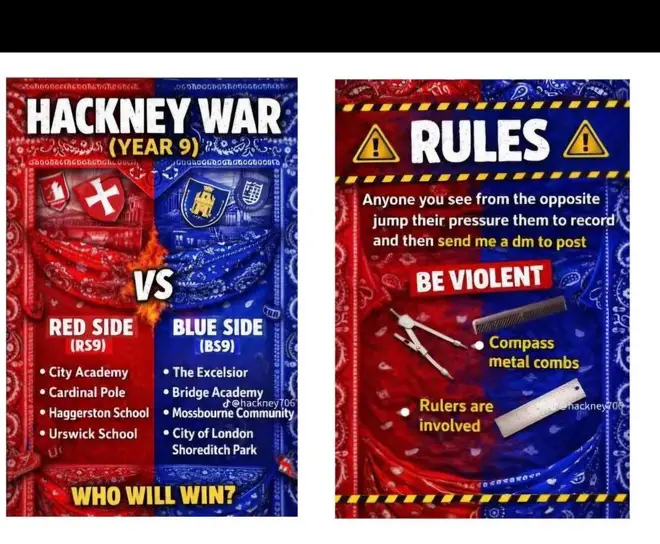
Posts on TikTok told teens to chase and attack students from other schools to earn points on a scoreboard. The posters were made using AI (artificial intelligence, meaning computer-generated content), which made them look slick and professional, and far more threatening than they might otherwise have seemed.
The videos named schools across Harrow, Tooting, Hackney, Bristol, and Croydon. One post told children to “be violent” and ranked acts on a scoreboard like a game.
Here is something important that many parents do not know. Research from the BBC found that most teenagers only heard about the posts because their parents shared them in WhatsApp groups first. Many teens were joking in the comments that they heard about the “school war” from their parents, not from their peers.
A professor of social psychology at Cambridge University explained that the red versus blue format was designed to trigger an “us versus them” reaction. His research found that each extra word attacking “the other side” made a post 67% more likely to be shared, which is exactly how these posts spread so fast.
Was it actually real?
This part matters. The Metropolitan Police confirmed that no actual violent incidents linked to the posts were reported. A police detective who spoke to the BBC described the real life reaction as an “over-reaction,” while also saying they had no choice but to take it seriously.
Experts call this a “phantom trend,” where fear around a post causes more harm than the post itself. It happened before with the Momo Challenge in 2019, where a scary character was said to be sending children dangerous instructions online. That turned out to be a hoax, but schools sent letters home and the panic became the real problem.
That does not mean you should ignore this. It means you should respond calmly, not in a panic.
What parents should do
These trends spread fast and the schools named can change daily.
- Check in with your child directly and ask if they have seen the videos
- Report content you see on TikTok or Instagram using the in-app report button (the flag or three dots icon on a post)
- Walk your child to school or set up a group commute with other parents if they feel unsafe
- Stay in contact with other parents. WhatsApp groups move fast and a group response works better than acting alone
- Do not pull your child out of school for a long time. A calm, planned response works better than a panicked one
- If you are worried about your child’s safety, contact your local police. You can call 101 for non-urgent concerns or 999 if you believe there is an immediate risk. You can also report online threats anonymously through Crimestoppers at 0800 555 111
One NHS worker in Croydon told reporters she had not worked mornings for days just to drop her son at school. Her husband took two days off for pickups.
How to talk to your kids about the School Wars in London
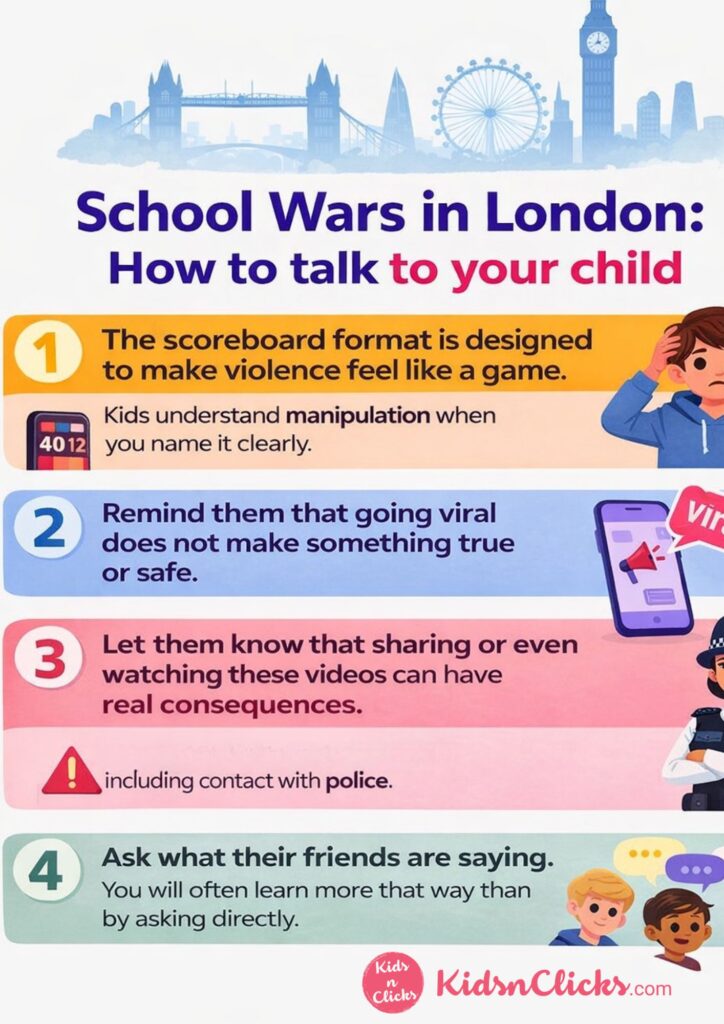
Start calm, not alarmed. Try asking “I saw some posts going around about schools, have you seen them?” before jumping into a warning.
- Tell them the scoreboard format is designed to make violence feel like a game. Kids understand manipulation when you name it clearly
- Remind them that going viral does not make something true or safe
- Let them know that sharing or even watching these videos can have real consequences, including contact with police
- Ask what their friends are saying. You will often learn more that way than by asking directly
Do not say “it’s probably just fake.” It makes your child feel unheard and it is not fully true either. If your child seems withdrawn or does not want to go to school, this trend could be why.
For teachers
Teachers are often the first to notice something is wrong, before parents or police. That matters a lot right now.
- Watch for unusual absence patterns in specific year groups or friendship groups
- Report concerns to your safeguarding lead (the staff member in school responsible for child safety) early. Do not wait for it to become obvious
- A short, calm form time chat with students goes a long way. Telling them staff are aware and taking it seriously helps reduce worry
- Share what you are seeing with parents where you can. Teachers often see the full picture that families miss
- If you have serious concerns about a specific threat or planned incident, contact the police directly. Call 101 for non-urgent reports or 999 if you believe violence is about to happen. Do not assume someone else has already made the call
Schools that sent staff to nearby bus stops on the day reported calmer students. Being visible and present makes a real difference.
The bigger picture
The response in Croydon worked because schools, parents, community workers, and police acted together quickly. No violence was reported on the day, and the community turnout was credited as the reason why.
This cannot be managed by one person or one group alone. Stay connected with other parents and teachers, keep talking to your kids, and do not hesitate to call the police if something feels wrong.