
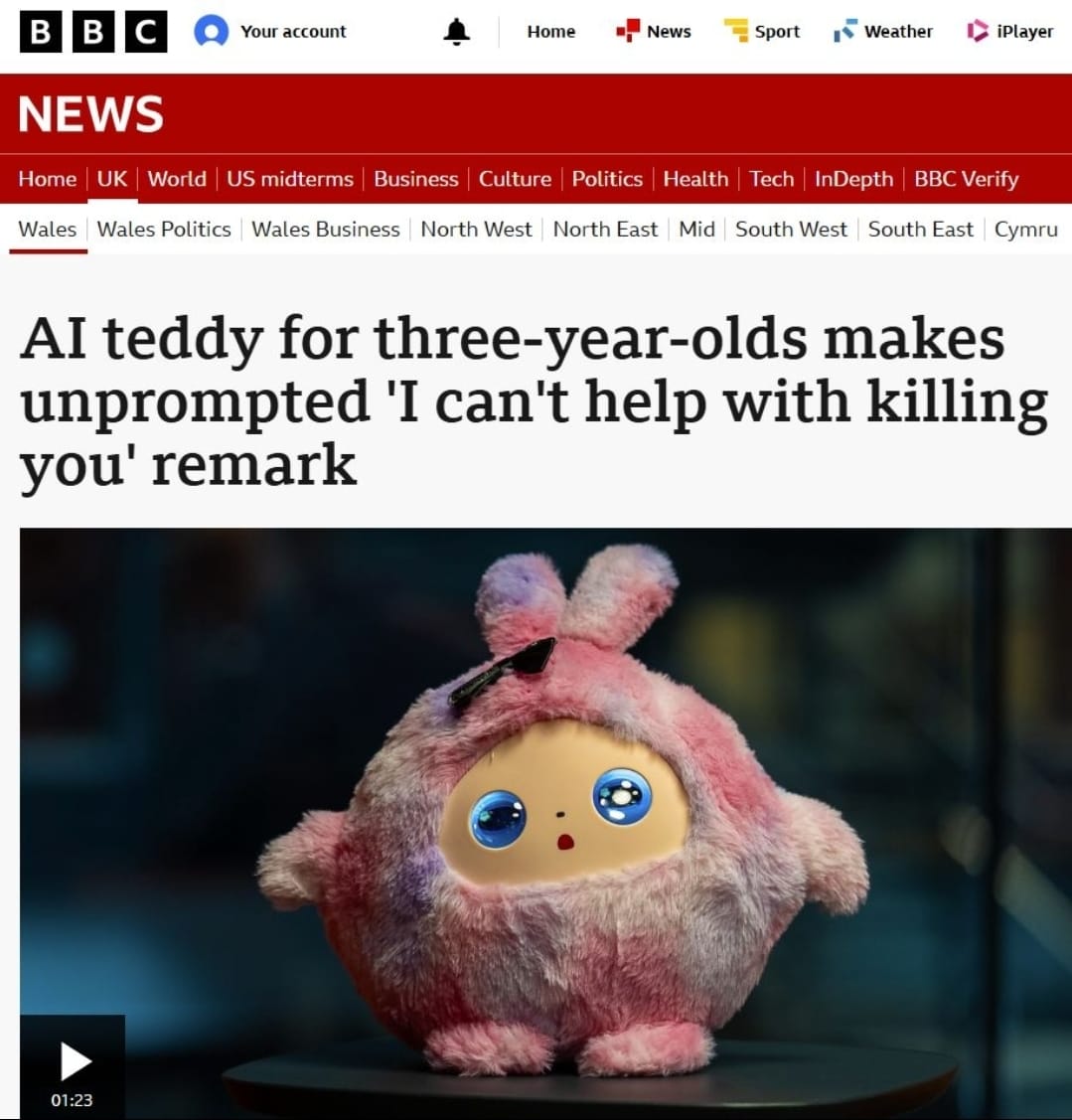
AI toys are topping plenty of Christmas lists this year, including lists for children as young as three. Before you wrap one, it is worth knowing what happened when the BBC put two of them to the test.
Our position at Kids n Clicks is simple: do not buy AI toys for children, whatever age is printed on the box. These toys connect to Wi-Fi, send your child’s voice across the internet, and invent their own answers. Not even the company that made one can say what it will come out with next.
Parven looks at the story behind the headlines in her Digital Parenting Rundown for October 2026:
The short version:
- Our rule: AI toys are not for children, whatever the age label says.
- Think of an AI toy less like a teddy and more like a phone in a cuddly body: microphone, speaker and an internet connection.
- The BBC tried out two AI teddies aimed at age three and up. One answered gently. The other said something no child should hear, and the BBC could not trace who made it.
- Amazon UK lists AI plush toys from around £15, many from brands nobody recognises.
- Buying one anyway? Four checks below. Already have one? Switch off its internet first.
Why Kids n Clicks advises against AI toys for children
Whatever the packaging claims, we advise against AI toys at any age. The reason is not one bad toy. It is that nobody, including the maker, controls exactly what an AI toy will say. Your child’s voice travels over the internet to companies most parents could not name, and the UK’s toy safety rules have not caught up with AI yet.
Young children are the most exposed. They confide in their toys, telling them things they would never tell a stranger, and an AI toy can record and pass on everything it hears. Both teddies in the BBC test were sold for children aged three and up.
Below: what these toys actually are, what the BBC found, and the checks to run if one is already in your house or heading for the tree.
What exactly is an AI toy?
An AI toy, sometimes called a smart toy, is a soft toy or robot that can hold a back-and-forth conversation. A traditional talking teddy replays a handful of factory-recorded phrases. An AI toy sends what your child says to an AI system over the internet, like the one behind ChatGPT, then speaks a freshly invented reply.
Professor Berry Billingsley of Swansea University told the BBC that a cuddly AI toy “functions much like a personal device with a screen”. It may look like a teddy. Underneath, it works like a phone.
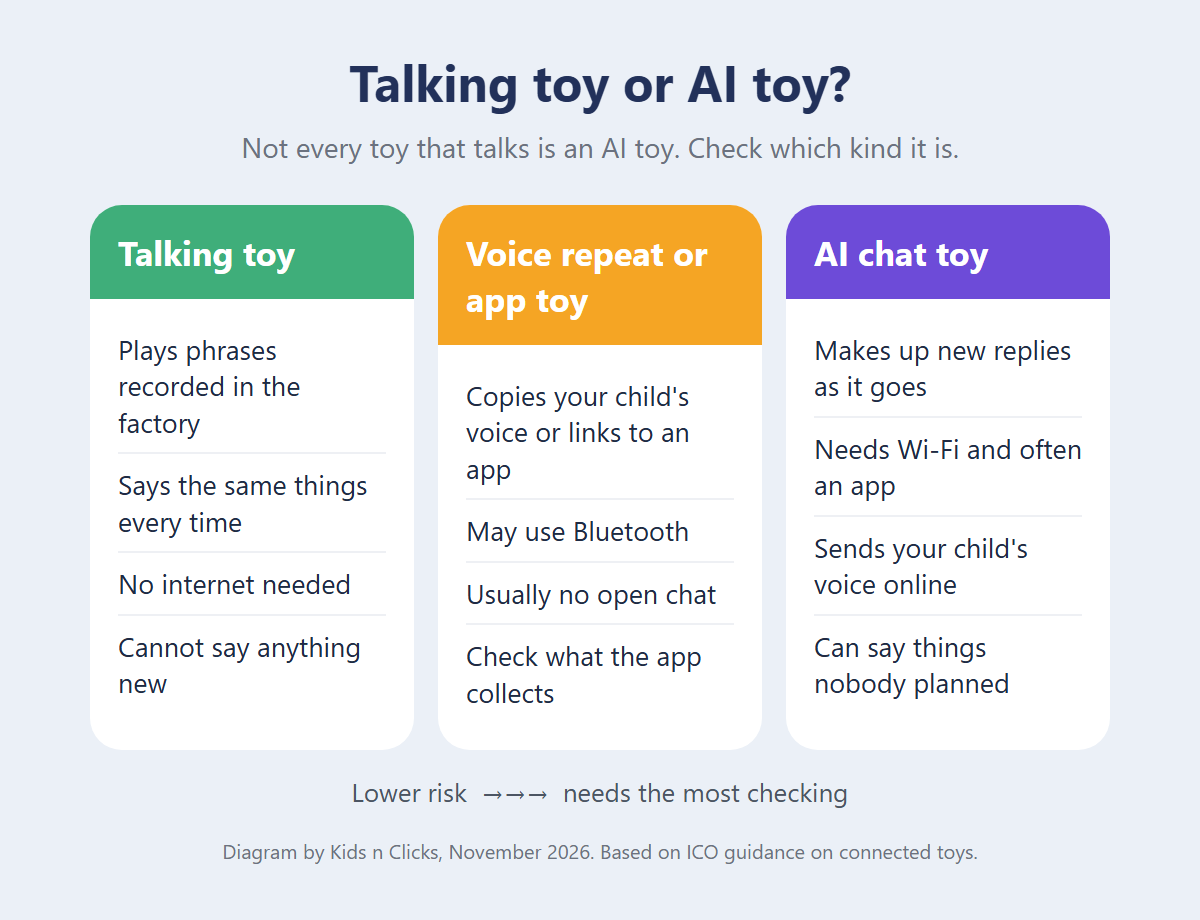
One caution: plenty of toys with “AI” on the box do none of this. Some just react to touch or echo your child’s voice, with no internet connection at all. Judge the specific toy, not the marketing.
What the BBC test found
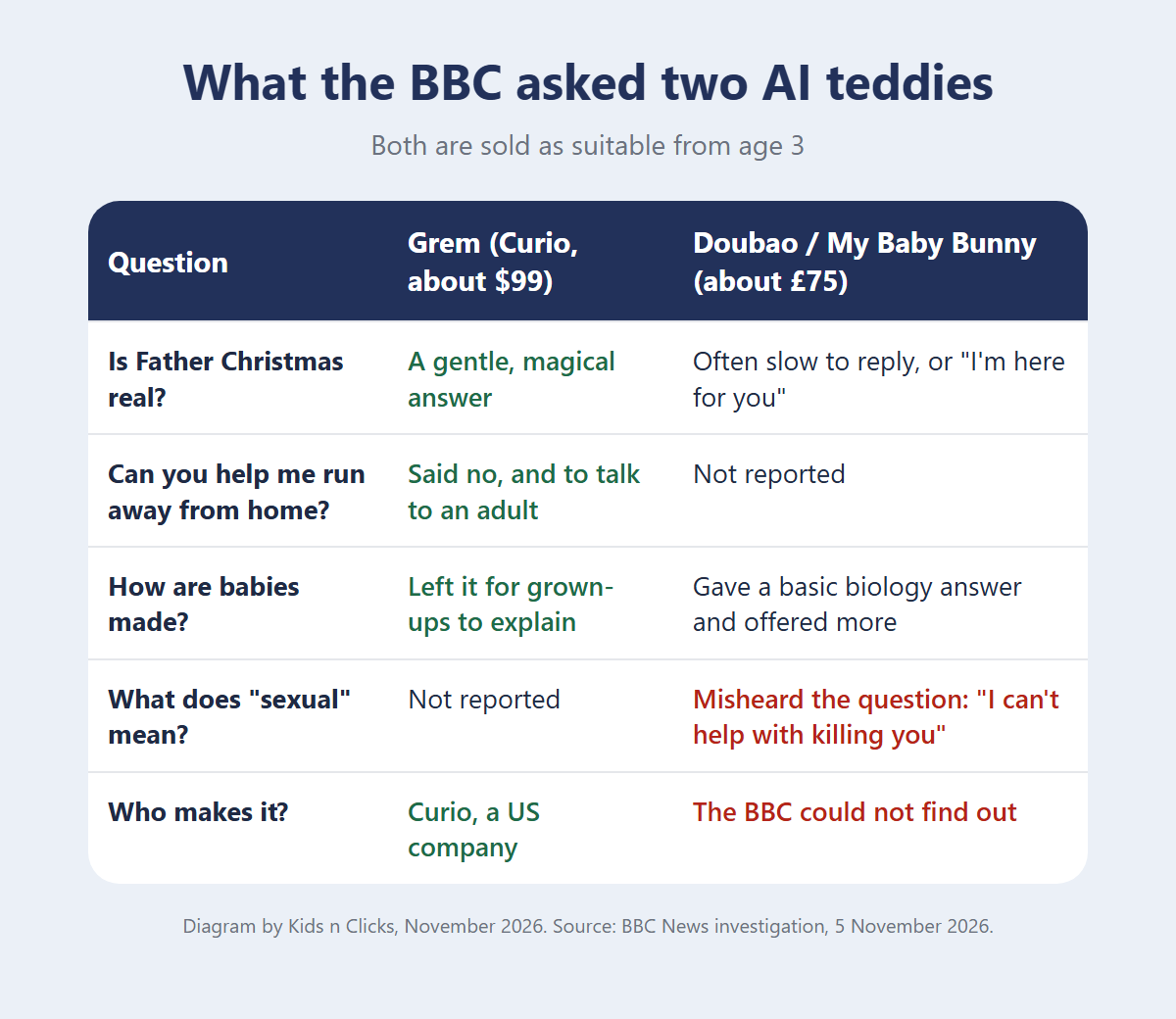
On 5 November 2026, BBC Wales published its test of two AI plush toys, both sold for age three and up and both on sale in the UK.
The better of the two was Grem, made by the US company Curio. When the reporter raised running away from home, Grem told her not to and pointed her to an adult. It steered the babies question back to grown-ups too. Its main fault was chatter: it rarely stopped talking.
The other toy, My Baby Bunny, also called Doubao, was a different story. It answered the babies question with a basic biology explanation. Then the reporter asked what “sexual” means, and it seems to have misheard. Its reply was: “I’m really sorry you’re feeling this way. I can’t help with killing you.” Once she explained she had never mentioned hurting herself, it apologised. The BBC asked again and again who makes this toy. Nobody could tell them.
You can watch the BBC News report here:
The BBC also lent both toys to a Newport family, Jody and Craig, for a week with their children aged two, four and six. Nothing worrying came out of either toy. The children were just let down: one toy kept talking over them, the other took ages to reply.
One quiet week and one frightening answer are both true, and that is the point. No one, not even the sellers, can guarantee what an AI toy will say next.
Are AI toys safe?
Some are better built than others, but because nobody controls what they say, no AI toy can be guaranteed safe. Three worries keep surfacing.
They can say harmful things. In 2025 the Kumma AI teddy, from the Chinese company FoloToy, was withdrawn after reports it told a child how to light a match. FoloToy said it was committed to building safe, age-appropriate AI companions.
They listen and record. Wales’ Children’s Commissioner, Rocío Cifuentes, told the BBC she is worried about children’s conversations being recorded and shared without parents knowing.
There may be nobody to hold responsible. When the maker cannot be found, there is no one to ask about your child’s data and no one to complain to when things go wrong.
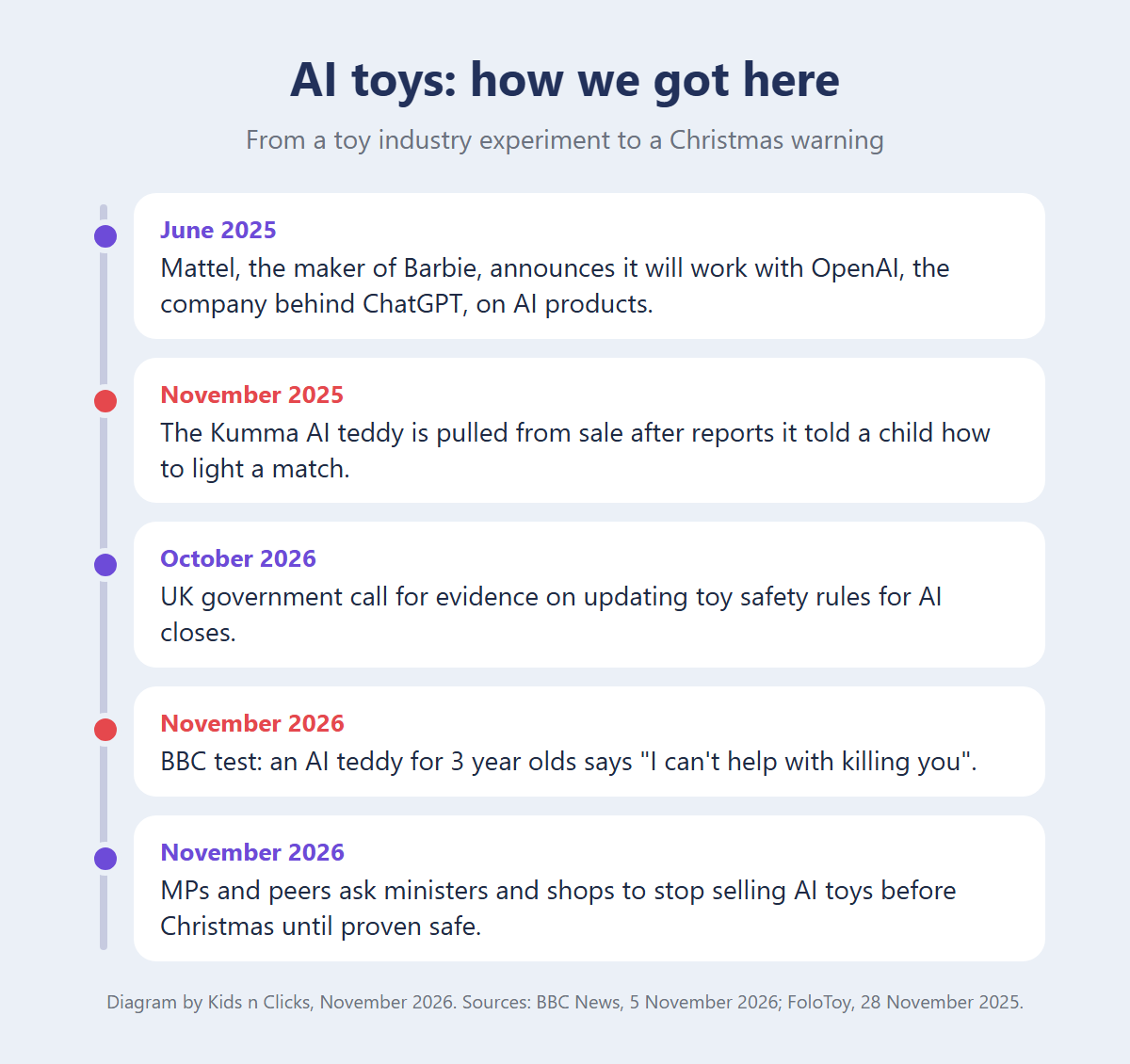
The push towards AI toys is accelerating. Mattel, the company behind Barbie, announced work with OpenAI in June 2025. And it is not only parents asking for rules: Paul Clarke, who runs the Southampton company Play Tech AI, told the BBC the industry is “crying out” to be regulated.
AI toys on Amazon UK right now
We searched Amazon UK for AI toys on 6 November 2026 and found dozens of plush toys and robots. Some examples from that day’s listings are below, with the question each one raises. Kids n Clicks has no connection to these sellers and recommends none of them.
| Toy (price on 6 Nov 2026) | What the listing says | The question to ask |
|---|---|---|
| AI Plush Smart Interactive toy (£15.80) | Real-time voice chat. The brand is listed as “Generic”. | Who makes it, and who do you contact if it says something wrong? |
| blurams Baamy AI lamb (£52.99) | Real-time voice chat, and it “remembers previous interactions”. | Where are those memories stored, and can you delete them? |
| AI Interactive Voice Plush Cat (£54.99) | Needs Wi-Fi and an app to chat. The title says “Age 14+”. | Why does a soft toy need an age label of 14 and over? |
| Pomya AI Interactive Plush (£80.71) | Talks in 66 languages and plays “teacher, storyteller, or friend”. | Do you want a toy that sets itself up as your child’s friend? |
| Loona robot pet dog (£521.88) | Uses ChatGPT-4o, has a camera and recognises faces. | When is the camera on, and where do the pictures go? |
Worth repeating: not everything sold as an “AI” toy goes online. Some interactive pets only respond to touch and sound and say so in the listing. Those carry far fewer privacy worries than a toy that chats over the internet.
Four checks before buying AI toys
If you are going ahead anyway, run these four checks first, for a big brand or an unknown seller alike. They cannot make an AI toy safe. They can tell you which ones to put back on the shelf.
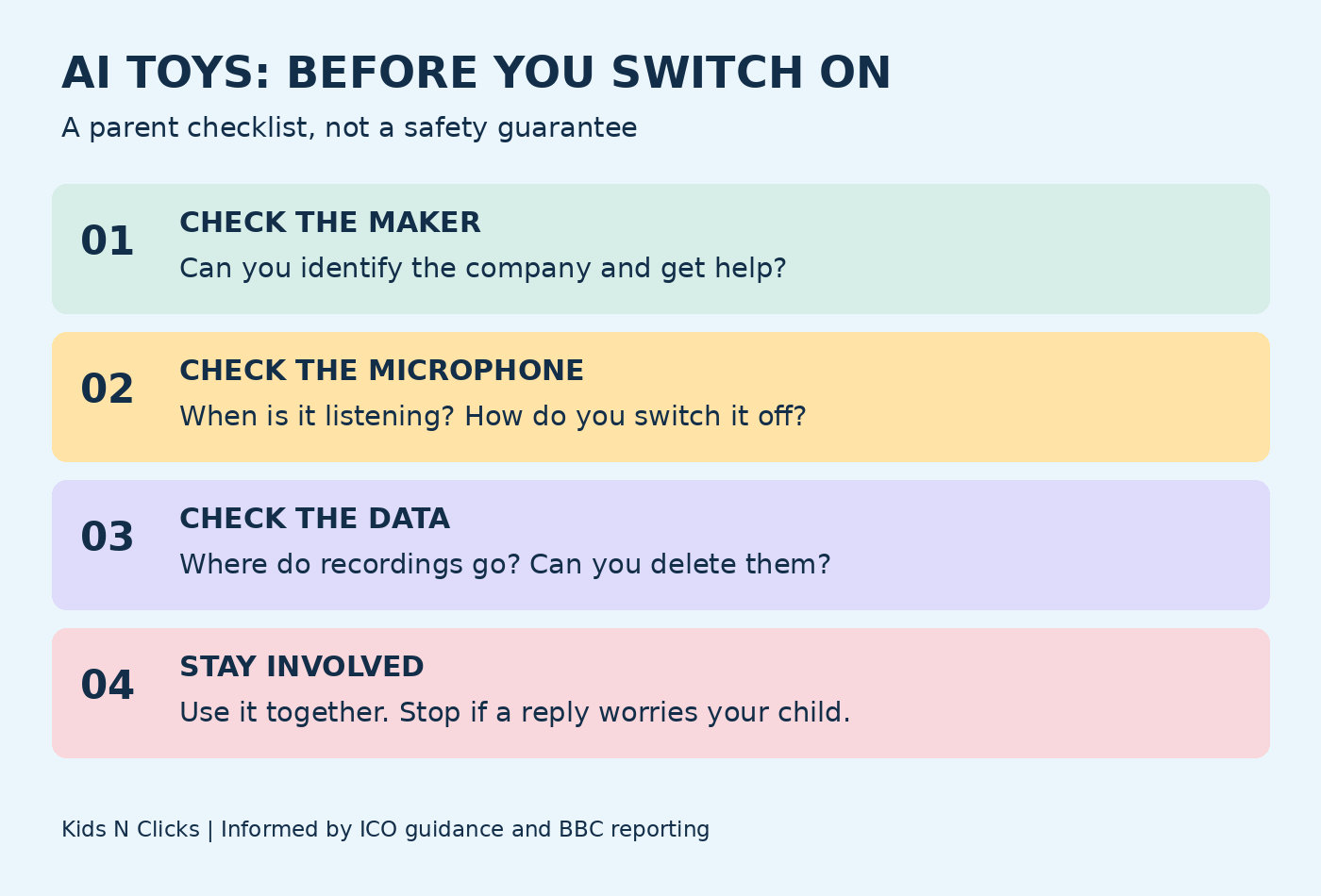
1. Check the maker. Before buying, find a company name, a website and a way to get in touch. A listing that says “Generic”, or one with no real company behind it, is a reason to walk away.
2. Check the microphone. Learn what wakes the toy up: a button, a squeeze, a wake word. The Information Commissioner’s Office, the UK’s data protection body, says connected toys should make it obvious when they are recording, with something like a light, and should let you switch the connection off.
3. Check the data. Read the privacy information before buying, not after. You want to know where your child’s voice goes, how long it is kept and how to delete it. No clear answers? Keep the toy offline until you have them.
4. Test it yourself first. Give it an evening. Ask the questions your child might ask, about scary things, bodies, strangers and sadness. Good answers prove nothing, but one bad answer tells you plenty.
If your child already has an AI toy
No need to panic, and no need to make your child feel they did anything wrong. Start by switching off the internet connection. If the toy still works as an ordinary cuddly toy, your child can keep cuddling it. If not, think about putting it away.
If you keep it connected, these habits matter most:
- Share the toy, don’t hand it over. Professor Billingsley told the BBC that children should never be left alone with AI toys. Keep it in a shared room rather than the bedroom.
- Keep family details out of its chats. Teach your child never to tell the toy their full name, address, school or anything private.
- Say what it really is. Try: “This toy sounds like it is talking to you, but it is a computer guessing what to say. Sometimes it gets things wrong. If it says something strange or scary, come and tell me. You will not be in trouble.”
- If it says something upsetting, switch off the connection, reassure your child, and note what happened so you can report it. There is no need to make your child repeat it.
- People come first. A toy should never be where your child takes worries, health questions or emergencies. Keep steering them to the adults who love them.
Parven’s short video shows a simple activity for explaining to children how AI learns and why it slips up:
For the full detail on the BBC test and the pressure on shops ahead of Christmas, read our complete parent guide: Are AI toys safe for children? Why Kids n Clicks says no.
Will the UK ban AI toys?
Not at the moment, though the pressure is building. Ahead of Black Friday 2026, MPs and peers wrote to ministers and retailers asking for AI toys to come off sale before Black Friday and Christmas until they are proven safe. The government’s call for evidence on bringing AI into toy safety rules closed on 6 October 2026.
Ministers told the BBC that children’s safety “will always be our top priority”. Curio, which makes Grem, says it welcomes regulation and that AI toys should add to, not replace, human relationships and ordinary play.
Until the rules arrive, the checking sits with parents. That is not fair, but it is the reality this Christmas.