
Meta has 3.5 billion daily users and a plan to turn some of them into gamblers. The app is called Arena. It targets 18 to 34 year olds and lets them bet on politics, sport, and news. Zuckerberg wants 100 million monthly active users and has made this a personal priority.
Right now, Arena is points-based. Players predict outcomes, earn badges, climb leaderboards, and get rewarded for being right. No real money changes hands. Yet.
Meta hasn’t ruled out switching to cash once users have built the habit.
That’s not a coincidence. It’s a playbook.
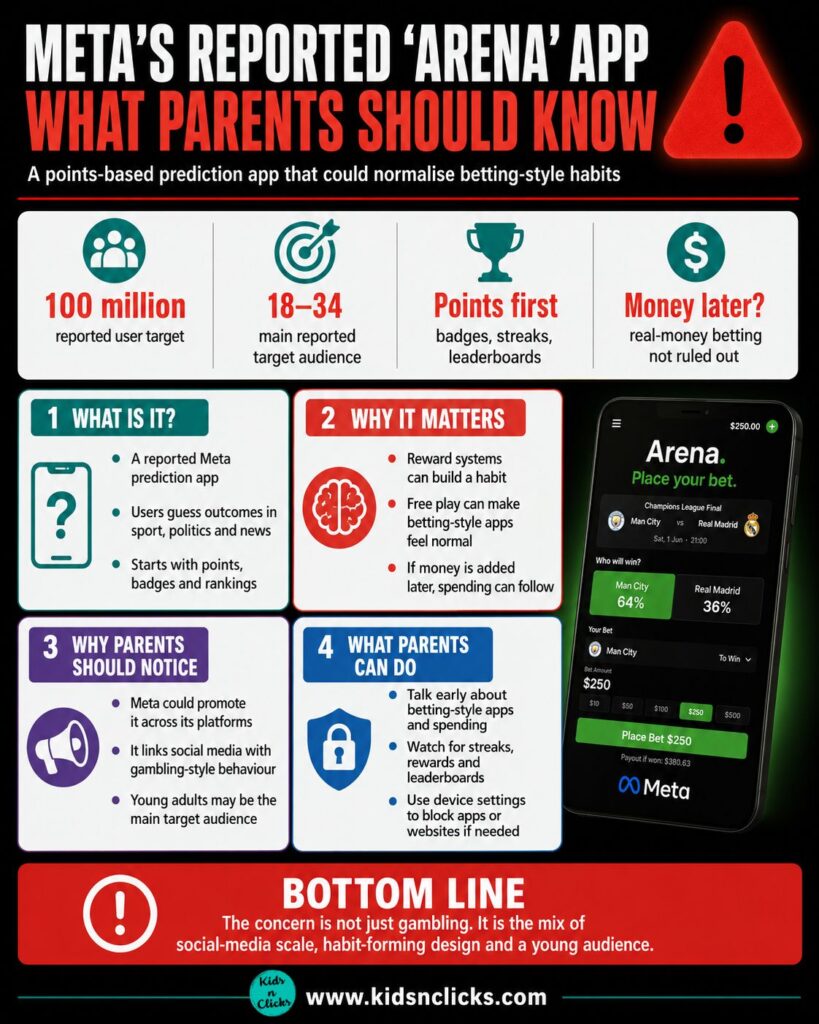
How the habit loop works:
- Free points lower the barrier to entry
- Leaderboards and badges keep people coming back daily
- Rankings create status and competition
- Real money, when it arrives, slots into a routine that already exists
This is exactly how gambling companies convert casual players into paying customers. You don’t start people on real money. You start them on free credits, build the daily check-in, then make it easy to upgrade.
Why 18 to 34?
Meta says it’s targeting this age group because they’re the right demographic. That’s true, but there’s more to it.
This is the same generation that grew up on Instagram and Facebook as teenagers. They formed habits on Meta’s platforms before they were old enough to question them. Now they’re adults, and in many places, they’re old enough to gamble legally.
Internal documents previously showed that around 10% of Meta’s ad revenue came from scam ads and banned goods, including illegal casinos. At the same time, Meta has ended its third-party fact-checking programme and cut its trust and safety teams. A company making billions from fraudulent gambling ads while reducing the staff who police them is now building its own gambling product.
The Regulatory Gap Is Deliberate
Starting with points isn’t just a product choice. It’s a legal strategy.
Several US states are currently suing prediction market operators for running unlicensed gambling. By keeping Arena points-based at launch, Meta stays out of that fight. The points phase builds the audience, the brand, and the daily habit before any regulator can classify it as gambling.
Meta will likely pilot Arena in markets where event betting is already legal, places like the UK, Australia, and parts of the US. Ireland is a strong candidate too. Meta’s Dublin operation is large, and the company has real lobbying power there. If Arena generates enough tax revenue, that leverage matters. It’s the same dynamic that lets the National Lottery in Ireland operate under far looser rules than standard gambling operators.
The Age Verification Trick
Zuckerberg lobbied Apple and Google to handle age verification so Meta doesn’t have to.
This matters for Arena. Proving someone is over 18 requires an identity check. If that responsibility sits with Apple and Google’s app stores rather than Meta, then Meta can launch a gambling-adjacent product without taking direct responsibility for verifying its users’ ages.
What Parents Should Know
If you’re a parent worried about Arena reaching your kids, the good news is that parental controls are strong right now. Both iOS and Android have built-in tools that let you block specific apps or categories of apps entirely. These controls are more effective than the kind of platform-level age bans that have made headlines recently, because they’re managed by you, not the app company.
Use them.
On social media more broadly, the safest approach is to hold off until 16 where you can. If that’s not realistic, 13 is the legal minimum age on most platforms, and that boundary should be treated as a floor, not a target.
How to Talk to Your Child About Apps Like This
Blocking an app is a practical step. But it works better alongside a conversation, not instead of one.
The goal isn’t to scare them. It’s to help them see what the app is actually doing, so they can spot the pattern themselves in future.
Start with how it’s designed, not why it’s bad.
Apps like Arena aren’t accidentally addictive. They’re built that way. Explaining that to a teenager is more effective than telling them it’s dangerous. Most kids respond well to being shown they’re being manipulated. Nobody likes to feel like a target.
Try something like: “This app gives you free points to get you started. Once you’re checking it every day, they plan to switch to real money. That’s the whole business model.”
That’s not a lecture. It’s just the truth, explained plainly.
Ask what they already know about gambling.
Most teenagers have seen betting ads. Some will have friends who use prediction apps or sports betting platforms already. Find out what they think before you tell them what to think. You’ll have a much better conversation.
Be honest about the grey areas.
Arena starts as a prediction game with no money involved. Your child might reasonably ask what’s wrong with that. It’s a fair question.
The honest answer is: nothing, right now. The concern is what it’s designed to become, and how the points phase builds a habit before the stakes change. Teaching kids to ask “what does this app want from me?” is more useful than a flat ban they’ll work around anyway.
Keep the conversation open.
If your child comes across Arena or something like it, you want them to tell you. That only happens if they don’t expect to be shouted at. Make it clear you’re not angry at them for being curious. You just want them to understand how these things work.
One conversation won’t be enough. These apps will keep coming. The skill you’re building is pattern recognition, not obedience.
The Bigger Picture
Meta is not doing anything illegal. It’s working the edges of what’s permitted, building habits before regulations catch up, and pushing age verification responsibilities onto others.
The DSA (Digital Services Act), which is EU law that governs how large platforms operate, has already flagged Meta’s addictive design patterns. The European Commission has issued preliminary findings against Facebook and Instagram for trapping younger users in compulsive behaviour loops. Penalties under the DSA can reach 6% of global annual turnover.
But here’s the thing about fines at that scale. When a company turns over tens of billions a year, even a 6% penalty becomes a cost that can be modelled, budgeted, and absorbed. It doesn’t change the product roadmap. It becomes a line in a spreadsheet.
Arena is a long-term bet that regulatory frameworks won’t move fast enough to stop it. Meta has made that calculation before. It’s usually been right.