
If you have a teenage son he probably knows who Sneako is.
A new Netflix documentary has put the “manosphere” back in the spotlight. But for most parents, the word itself is confusing. So let’s break it down clearly, because this goes much deeper than just some controversial YouTube videos.
What Is the Manosphere?
The manosphere is a network of online videos, podcasts, and social media accounts aimed at young men and boys. The creators talk about masculinity (what it means to be a man), success, relationships, and why they believe modern life is unfair to males.
Some of it sounds like motivation. A lot of it isn’t. And underneath the surface, there’s serious money being made from your son’s attention.
What the Netflix Documentary Shows
The Netflix documentary doesn’t just expose the content. It exposes the people behind it.
One of the most striking moments comes from a creator known as HS, or Harrison. He openly admits on camera that he knows young boys are his audience. Then he says something that should stop every parent cold: he stated that young boys should not be watching his content.
He knows. He said it himself. And he kept going anyway.
The documentary also pulls back the curtain on something many of these creators share: broken childhoods. Many of them grew up without fathers. They experienced instability, rejection, and pain that never got properly dealt with. That doesn’t excuse what they do. But it does explain a lot about why the content sounds the way it does. These are often wounded men, selling a fantasy of power and control they never had growing up, to boys who are desperate for exactly that kind of guidance.
The cycle is uncomfortable to look at. Boys without strong male role models watch men who also grew up without strong male role models, pretending they have it all figured out.
Who Are the Key People Right Now?
Andrew Tate is the name most parents recognise. He exploded online in 2022 and became one of the most searched people on the internet. He’s since been banned from most major platforms and faces serious legal charges in Romania. Most teenagers have moved past him. He’s almost too obvious now.
Sneako is the more urgent name. His real name is Nicolas Kenn De Balinthazy. He started making normal lifestyle content on YouTube, then gradually shifted into manosphere territory. He became one of Tate’s closest public allies.
He was banned from YouTube and Twitch for hateful content, but his videos kept circulating everywhere. He’s now partially unbanned and appeared in Netflix content, which has brought him a whole new wave of young viewers.
Other names in the space:
- Fresh and Fit – a podcast built around putting women down as entertainment
- Kevin Samuels (now deceased) – gained millions of followers giving brutal, often cruel “advice” to women on livestreams
- RooshV – known for extreme content around dating and masculinity
- Patrick Bet-David – more business focused, but shares the same audience and ecosystem
The newer creators tend to be younger, funnier, and far more relatable to teenage boys than Tate ever was. That’s exactly what makes them more effective.
It’s Not Just Content. It’s a Business.
This is the part most parents miss completely.
These creators aren’t just making videos. They’re running businesses, and your son is the customer they’re grooming (slowly building trust with) from the age of 12 or 13.
The pipeline works like this:
- Free content hooks boys in with relatable frustrations about school, girls, and feeling lost
- Courses and programmes sell them the idea that they can learn to be “high value men” for anywhere from $97 to several thousand dollars
- Investment schemes promise financial freedom through crypto, dropshipping, or exclusive membership communities
- Merch and lifestyle branding sell the image of wealth, travel, and status
Andrew Tate’s “Hustler’s University” (later rebranded as “The Real World”) charged a monthly fee and used members to actively promote his content online in exchange for small commissions. It was structured less like a course and more like a recruitment system.
Sneako and others operate similarly. The free YouTube videos are just the top of the funnel. The goal is to sell boys a lifestyle they desperately want, usually involving fast cars, beautiful women, expensive watches, and financial independence. Most of the people selling it are renting the cars for the video.
Why Boys Fall For It
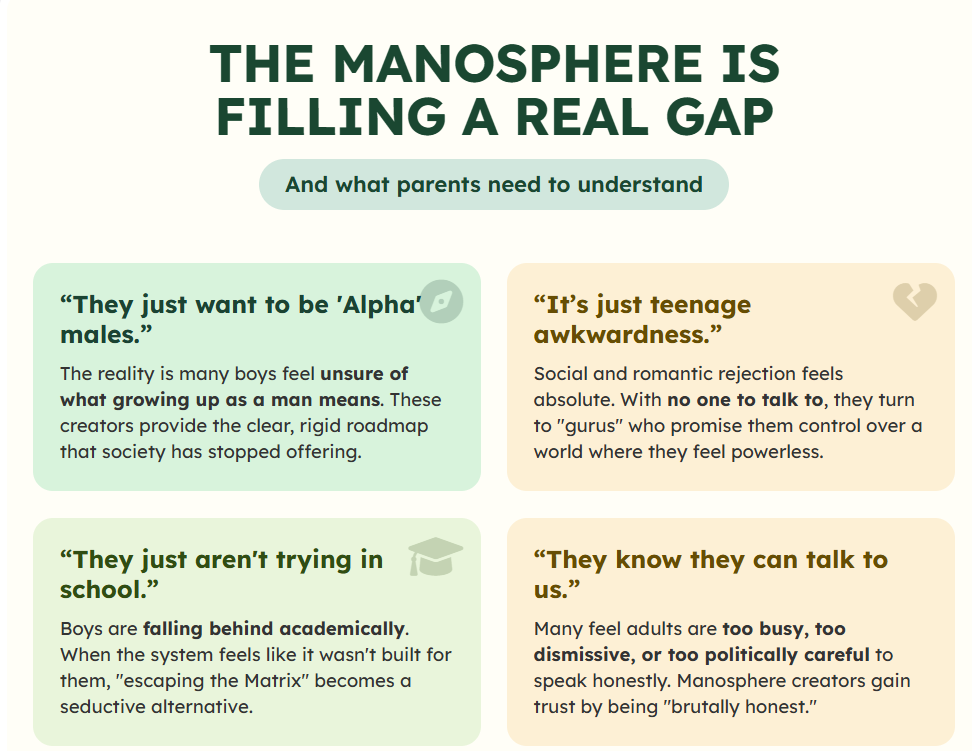
These creators are filling a real gap. That’s the uncomfortable truth parents need to sit with.
A lot of young men genuinely feel:
- Unsure of what growing up as a man actually means
- Rejected socially or romantically and with no one to talk to about it
- Left behind academically while feeling like the system wasn’t built for them
- Like the adults around them are too busy, too dismissive, or too politically careful to speak honestly
- Addictive algorithm pushing the same narrative
These creators speak directly to those feelings. They say things like “nobody tells boys the truth anymore” and “men are being left behind.” To a 14-year-old who feels invisible, that’s a powerful thing to hear.
The motivational content comes first. Work hard. Go to the gym. Have discipline. That part isn’t wrong. It’s the gateway into everything else.
Why Banning Doesn’t Work
Even when these creators get banned from YouTube, Instagram, or TikTok, the content doesn’t disappear. Fans re-upload it within hours. Creators move to platforms like Rumble or Kick. Their private Discord and Telegram communities (invitation-only online chat groups) keep running with tens of thousands of members. Their podcasts stay up on Spotify untouched.
Sneako is the clearest example. He was banned. His reach barely dropped. Then he came back. Banning slows them down for about a week.
How to Actually Talk to Your Son About This
This is where most parenting advice falls apart. It tells you to “have a conversation” without telling you how. So here’s something more practical.
First, understand why the standard approach fails.
Most boys who are deep into this content have already heard the word “toxic” applied to everything they find interesting. The moment you lead with “this is toxic masculinity,” the conversation is over. He’s heard it. It doesn’t land. It actually pushes him further in, because it confirms what these creators told him: that adults will just dismiss anything aimed at men.
Start With Curiosity, Not Concern
The single biggest mistake parents make is opening with worry. It signals to a boy that he’s about to be lectured, and his defences go up immediately.
Try this instead:
- “I saw something about this online. What do you actually think of these guys?”
- “Someone sent me a Sneako clip. Is he actually funny or is it all just an act?”
- “I watched a bit of that Netflix documentary. Some of it was pretty wild. Have you seen it?”
You’re not pretending to be cool. You’re being genuinely curious. There’s a difference, and teenagers can feel it.
The goal of the first conversation is not to change his mind. It’s just to keep the door open.
Don’t Dismiss the Parts That Are Real
If your son says “Andrew Tate is right that men should work hard and be disciplined,” he’s not wrong. Tate says things that are true. So does Sneako. That’s why it works.
If you dismiss all of it as rubbish, you lose credibility. You also miss the point.
Try saying: “Yeah, some of that stuff about discipline and working hard is genuinely solid. What do you think about the other stuff though, the way they talk about women?”
You’ve agreed on common ground. Now you can actually go somewhere.
Ask Him to Think Like a Detective
Boys this age respond well to logic and challenge. Instead of telling him what to think, ask him to question what he’s watching.
Some questions that work:
- “If this guy is so successful, why does he need to sell a course about it?”
- “He’s talking about being rich on a rented yacht. How do you know what’s real?”
- “Do you think someone who genuinely respects himself needs to put other people down to feel better?”
- “What do you think his childhood was actually like?”
You’re not attacking the creator. You’re teaching your son to think critically, which is a skill that protects him from every kind of manipulation, not just this one.
Talk About the Business Model Directly
Most teenage boys have a strong sense of fairness. They hate being taken advantage of.
Explain it plainly:
“These guys make money when you watch, when you share their videos, and when you eventually buy their courses. The whole thing is designed to make you feel like you’re missing something, so you’ll pay to fix it. That’s not a mentor. That’s a sales funnel.”
A sales funnel is a marketing term for a system that turns a viewer into a paying customer, step by step. Once your son understands he’s being marketed to, not mentored, something shifts.
Bring Up the Fatherless Angle Without Making It Weird
If your son has watched the Netflix documentary, or if you watch it together, the childhood stories of these creators are genuinely useful to discuss.
You can say something like: “It’s kind of sad actually. A lot of these guys clearly had really rough starts. No dad around, instability at home. And now they’re out here performing this tough guy thing for millions of kids in the same situation.”
This builds empathy without excusing the behaviour. It also gives your son a more complete picture of who he’s actually listening to.
If There’s No Father in the Home
This matters and it’s worth saying directly. Boys who are growing up without a father figure are significantly more likely to be drawn deep into this content. That’s not a criticism of single mothers. It’s just a pattern worth knowing.
If you’re a single mum, think about the men already in your son’s life:
- An uncle, older cousin, or grandfather he respects
- A coach or teacher he connects with
- A family friend who models a healthy version of masculinity
You don’t need to stage anything. Just make sure those relationships have space to grow. A real man in his life who listens to him is the most powerful counter to anything Sneako posts online.
Know When It’s Gone Too Far
Most boys dip in and out of this content without it becoming a real problem. But watch for these signs that it’s moving into something more serious:
- He’s started spending money on courses or programmes
- He talks about women with consistent contempt, not just teenage awkwardness
- He’s pulling away from female friends or family members
- He’s become secretive about his online activity
- He’s repeating specific ideological phrases like “women belong at home” or “men are oppressed”
If you’re seeing several of these together, a conversation with a school counsellor or a therapist who works with adolescent boys is worth considering. It’s not an overreaction.
The Bigger Point
These creators got famous because too many boys felt like no one was talking to them honestly. They felt invisible, confused, and a little bit lost. And some man on YouTube looked them in the eye and said “I see you.”
That’s a powerful thing. And it’s something a parent can do too.
You don’t need to have all the answers. You just need your son to know he can bring the hard stuff to you and you won’t panic, lecture, or shut it down before he’s finished talking.
That’s harder than it sounds. But it matters more than any content filter ever will.