
Most people in Clapham thought Tuesday evening was just another normal day on the high street. By 7pm, hundreds of teenagers were sprinting down the road, blocking traffic, and forcing shops to lock their doors. Families were stuck inside. A pregnant woman hid from the chaos. Four police officers were hurt.
This is what “steaming” looks like in 2026.
What is steaming?
Steaming is when a big group of people swarm a place together, often causing trouble and sometimes violence It used to mean gangs robbing people on trains and buses. Now it means something bigger, because social media makes it spread way faster.
The newer version is called a “link-up.” Here is how it works:
- Someone posts a meeting spot on TikTok or Snapchat
- Others share it and it blows up fast
- Hundreds of teenagers show up at the same place
- There is no leader and no plan, which makes it really hard for police to stop it early
How does it spread?
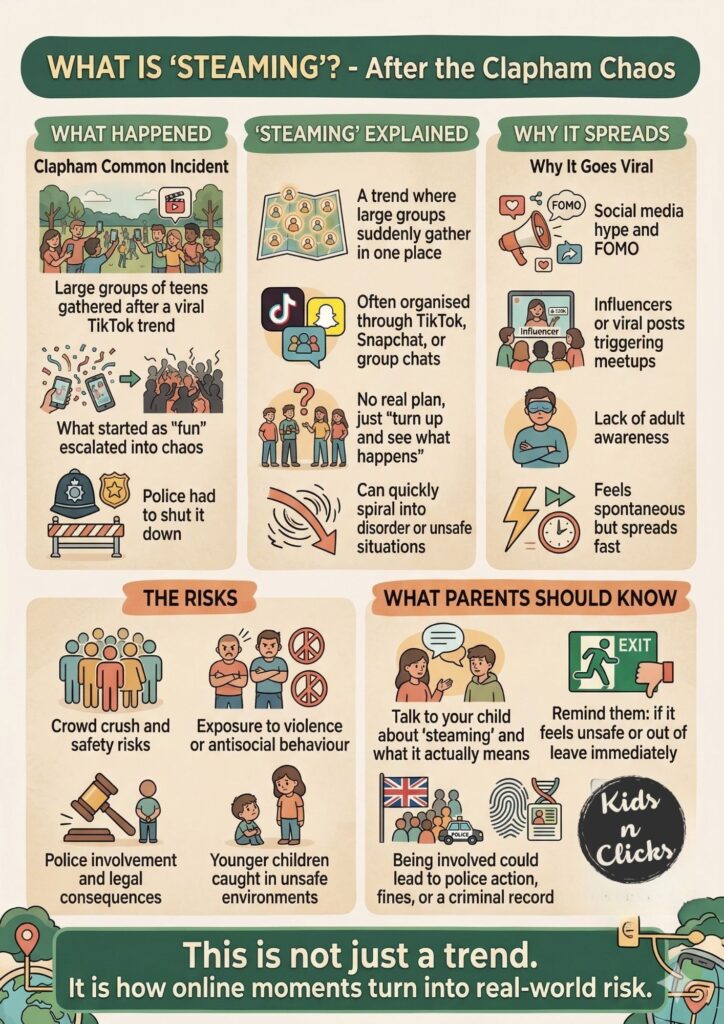
The link-up trend sees people post on social media, calling for as many others as possible to gather in one spot. Once a video of a big crowd gets online, it starts the next one.
Why it spreads so fast:
- Kids who missed it want to be there next time
- Teens in other cities see the videos and copy the idea
- The more wild the video looks, the more views it gets
- The more views, the more people want to join the next one
The chaos started in Birmingham on Friday, then moved to Clapham over the weekend, then Solihull on Monday, with police warning that videos online were inspiring copycat events across the country. Britannia Daily
One TikTok video showed two girls dancing at home with the caption “How we feel knowing it’s gonna be live at Clapham Courts on Tuesday,” showing just how openly these meetups get planned. British Brief
What happened in Clapham?
The trouble hit Clapham twice in one week.
Saturday 28 March:
- Over 100 teenagers gathered at Clapham Common basketball courts then swarmed the high street
- Shops including M&S and Sainsbury’s were targeted
- Three girls, aged 15 and 16, were arrested for shoplifting and assault
Tuesday 31 March:
- Between 200 and 300 teenagers, many in masks and balaclavas, filled Clapham High Street and Clapham Common as part of an Easter holiday link-up East London Times
- M&S, Sainsbury’s, Holland & Barrett and McDonald’s all shut their doors
- Fires were lit on Clapham Common and fireworks were set off
- Around 100 police officers were sent to the area
- Four officers and one member of the public were hurt
Three girls arrested after Tuesday:
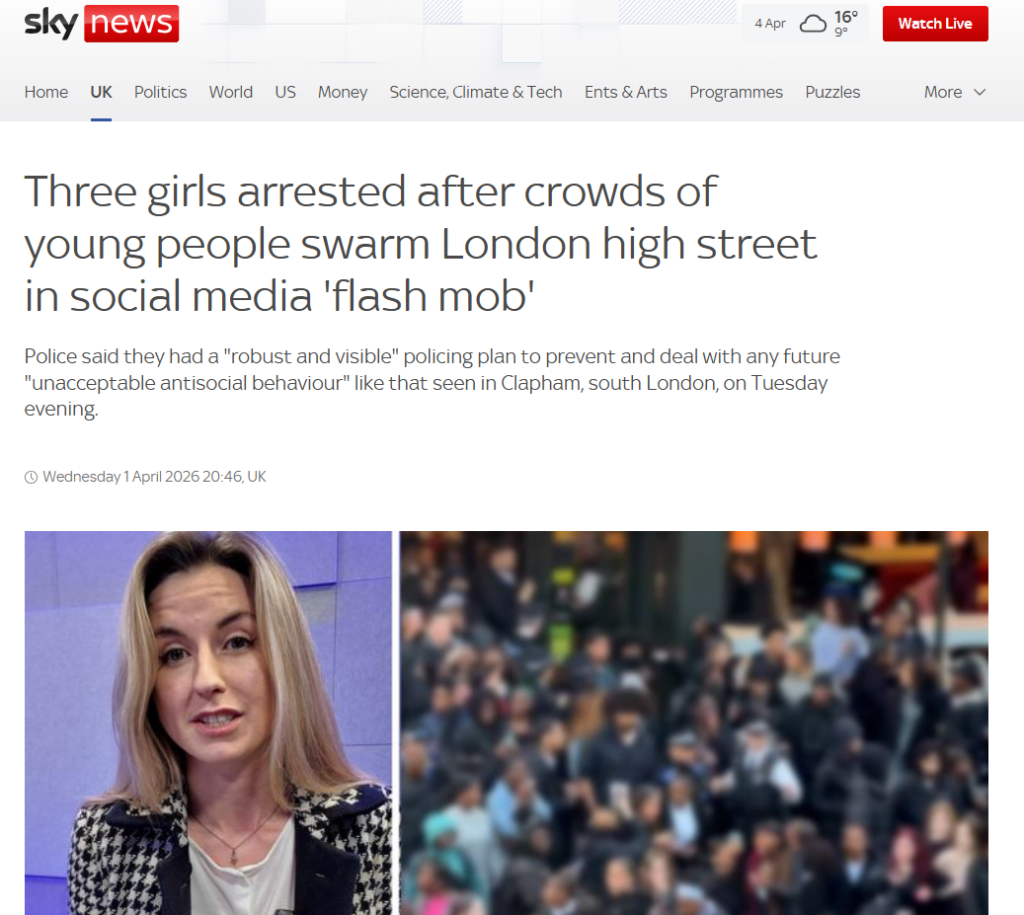
- A 17-year-old, charged and due in court later in April
- Two 13-year-olds, both released on bail
- All three arrested for attacking an emergency worker
That brought the total to six arrests across both days.
Where else has it happened?
Clapham was not the only place hit. Mobs of teens ran riot across UK cities as the trend kept growing online. LBC
- Birmingham – trouble broke out on Friday before Clapham
- Solihull – more chaos followed on Monday
- London parks – Burgess Park and Crystal Palace Park were named as possible spots for the next link-ups
What are police doing?
- Sending more officers to areas where link-ups are planned
- Using dispersal orders, which means police can tell a crowd to leave or face arrest
- Checking CCTV and body camera footage to make more arrests
- Warning parents to know where their kids are
The Met said bluntly: “Just because you have not yet been arrested does not mean you will not be.”
Detective Chief Superintendent Emma Bond added: “Events like this, fuelled by viral content on platforms like TikTok, can quickly get out of hand. If you join in, you should expect to be arrested and risk a criminal record that can affect your future job and travel.”
The legality: what students need to understand
This is the part a lot of teenagers miss. You do not have to steal anything, hit anyone, or even do anything wrong to end up in serious legal trouble at one of these events. Here is what the law actually says, in plain terms.
Just being there can get you arrested
- If police issue a dispersal order (an official instruction telling a crowd to leave an area) and you stay, you can be arrested
- If you are seen in a group that is causing trouble, even if you personally are not, police can still detain you for questioning
- Being in a crowd that is blocking a road or causing people to feel scared is called “threatening behaviour” or “causing a public nuisance,” both of which are crimes
Sharing or posting videos is not safe either
- If you film someone being attacked and share it, you could be investigated for encouraging or sharing evidence of a crime
- Posting a link-up location online, even as a joke or repost, could make you partly responsible for what happens there
- TikTok, Snapchat and Instagram all pass data to police when asked. Your account is not anonymous
What age does the law apply from?
- In England and Wales, the age of criminal responsibility is 10 years old. That means children as young as 10 can be arrested and charged with a crime
- Two of the girls arrested in Clapham were just 13 years old
- Being young does not mean you escape consequences. It means you go through the youth justice system instead, but you still get a record
What a criminal record can actually do to your life
A lot of teenagers think a criminal record is just a telling off. It is not. Here is what it can affect:
- Jobs – many employers ask if you have a criminal record, and some jobs like nursing, teaching, law and working with children will be closed to you
- University – some courses and student visa applications ask about criminal records
- Travel – the USA, Canada and Australia all ask about criminal convictions when you apply for a visa or entry. A record can mean you are refused entry
- Apprenticeships – many require background checks before you start
The honest truth
The girls arrested in Clapham did not plan for their week to end in a police station. Two of them were 13. One of them is now due in court. None of that can be undone. A five-minute moment on a high street, caught on dozens of cameras and shared millions of times, is now part of their permanent record.
Police have said clearly that more arrests are coming as they go through the footage. If you were there, or you know someone who was, now is the time to talk to a trusted adult.
What parents can do
If you have a teenager at home, here is what you need to know and do.
How to talk to your child about it:
Talking about this does not have to turn into a big argument. Keep it simple and calm:
- Ask open questions like “have you seen these Clapham videos?” to start the chat naturally
- Do not lecture. Ask them what they think about it first
- Explain that being in the crowd, even if they do nothing wrong, can still lead to arrest
- Tell them police are going through every video and identifying faces
- Make clear a criminal record at 13, 15 or 17 is not just a warning, it can block jobs, university places and travel visas later in life
- Let them know they can always call or text you to be picked up, no questions asked
Practical steps:
- Know roughly where your child is going and who with
- Check in by text during the evening, especially during school holidays
- Make sure they know the difference between a fun hangout and a situation that is getting dangerous
- Remind them that if things kick off, walking away fast is always the right move
What schools and colleges can do
Teachers and school staff are often the first to hear about these events, sometimes before parents do. Here is what schools can do to help:
- Talk about it in PSHE lessons (Personal, Social, Health and Economic education, the class that covers real-life issues). Use the Clapham videos as a real example. Ask students what they think, not just what they are told to think
- Brief form tutors so they can spot if students are planning to attend or have already been involved
- Send a message to parents before school holidays, flagging the trend and what to watch for
- Work with the school police officer if there is one, to give students a clear picture of what happens legally if they get arrested
- Avoid scare tactics that do not work. Focus on real outcomes like criminal records, not just “you will get in trouble”
- Create a safe space where students can talk about peer pressure. Many teenagers go to these events because their friends are going and they do not want to feel left out. Talking about that pressure openly helps more than a one-way lecture
The bottom line
This is not just a London problem. It is spreading across the UK and it is being driven by teenagers daring each other online to show up. The videos make it look exciting. The reality, for the six girls already arrested and the more still to come, is anything but.
Police are going through every piece of footage. More arrests are coming. And a five-minute thrill on a high street is not worth a criminal record that follows you for years.