
Most parents focus on how long their child is online. That matters. But the bigger issue is what they’re being shown while they’re there.
Children don’t usually go looking for harmful content. It finds them.
The algorithms that run platforms like TikTok and Instagram are designed to keep people watching for as long as possible. They do that by pushing content that gets a strong reaction, things that are shocking, upsetting or extreme.
A child starts watching something completely harmless. Gradually the feed shifts. More intense content gets mixed in. And because they’re young and haven’t experienced much of the real world, it starts to feel normal to them.
One doctor in the report described it like a slot machine. The more shocking the content, the more clicks it gets. That’s how these platforms make money. Children are caught inside that system.
What doctors are actually seeing
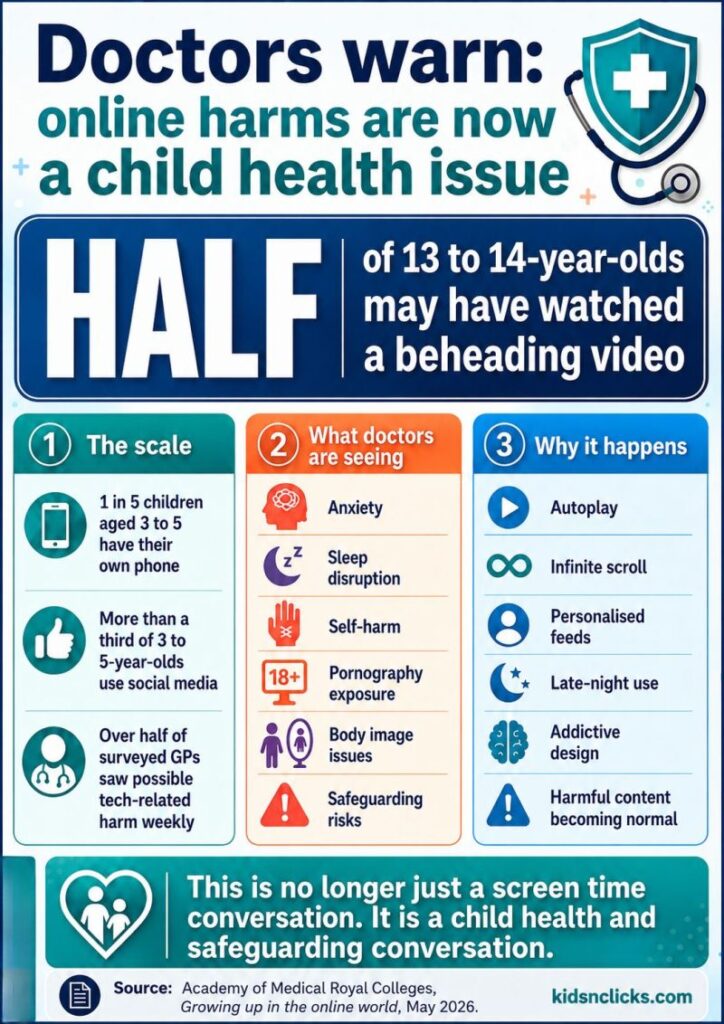
More than half of the GPs surveyed had seen at least one child each week whose health problems they linked to screens and devices. Over a third were seeing it multiple times a week.
Child psychiatrists, paediatricians and mental health professionals reported the same.
The conditions they’re treating include anxiety, depression, self-harm, sleep problems, eating disorders, body image issues, and children who have been groomed or exposed to extreme content online.
One consultant child psychiatrist put it plainly. Mental health services are being asked to treat what is a completely normal response to being endlessly exposed to hateful, addictive and deeply distressing content.
The numbers that are hard to ignore
A Home Office psychiatrist told the Academy that UK studies suggest half of all 13 to 14-year-olds may have watched a beheading video.
On pornography:
- 13 is the average age a child first sees it
- 59% of children first saw it by accident
- 27% had already seen it by age 11
On night-time use, across YouTube, Snapchat, TikTok and WhatsApp, between 15 and 24% of children’s total online time happens between 9pm and 5am.
The real problem isn’t just screen time
Most parents focus on how long their child is online. That matters. But the bigger issue is what they’re being shown while they’re there.
Children don’t usually go looking for harmful content. It finds them.
The algorithms that run platforms like TikTok and Instagram are designed to keep people watching for as long as possible. They do that by pushing content that gets a strong reaction, things that are shocking, upsetting or extreme.
A child starts watching something completely harmless. Gradually the feed shifts. More intense content gets mixed in. And because they’re young and haven’t experienced much of the real world, it starts to feel normal to them.
One doctor in the report described it like a slot machine. The more shocking the content, the more clicks it gets. That’s how these platforms make money. Children are caught inside that system.
What you can actually do
This isn’t about being a perfect parent or monitoring every second of your child’s screen time. It’s about being present, having conversations, and making some deliberate choices.
Delay access where you can
The longer you can hold off on giving your child their own social media accounts, the better. Most platforms set 13 as their minimum age, but that’s a legal threshold, not a safety guarantee. Many child health professionals recommend holding off until 16 if at all possible.
It’s not always easy. Social pressure is real and your child will push back. But every year you delay is a year their brain has more time to develop the ability to process what they see.
If they already have access, that’s okay. You’re not starting from zero. Focus on what you can do from here.
Keep phones out of bedrooms at night
This is one of the most practical changes you can make right now. The data in this report shows that a significant chunk of children’s online time happens between 9pm and 5am. That’s unsupervised, late-night access to content that can be disturbing, addictive and completely age-inappropriate.
A simple rule, phone charges downstairs overnight, makes a real difference. Frame it as a family habit rather than a punishment. Many parents find it helps their own sleep too.
Start the conversation, but don’t make it an interrogation
Talking to your child about what they’re seeing online works best when it doesn’t feel like a grilling. Start with something low-pressure.
Ask how social media makes them feel. Not what they’re watching, but how it leaves them feeling after. Do they feel good? Tired? Anxious? Compared to their friends? That question alone can open up a lot.
Some other ways in:
- “Has anything come up on your feed lately that felt weird or uncomfortable?”
- “Do you ever feel like you can’t stop scrolling even when you want to?”
- “What do your friends talk about that they’ve seen online?”
You’re not looking for a confession. You’re building a habit of talking. Children who feel they can come to a parent without being judged or having their phone taken away are far more likely to tell you when something genuinely worries them.
Talk about how the algorithm works
Most children don’t know that what they see in their feed isn’t random. Explaining that platforms are designed to keep them watching, and that the more extreme content gets pushed harder, can actually help children feel less powerless.
When they understand the system, they can start to question it. You might say something like: “The app isn’t showing you this because it’s good for you. It’s showing you it because it keeps you on longer, and that makes the company money.”
That’s not a scary conversation. It’s an honest one. Children respond well to being treated like they can handle the truth.
Watch for the signs
You know your child. Trust what you notice.
Changes to look out for:
- Mood shifts after time online, irritable, withdrawn, or flat
- Disturbed sleep or reluctance to hand over the phone at night
- Secrecy around what they’re watching
- New anxieties about their body, their relationships, or the world
- Loss of interest in things they used to enjoy
None of these on their own means something is wrong. But a pattern is worth paying attention to. If you’re worried, start with a conversation rather than an immediate crackdown. And if your concern deepens, talk to your GP.
The harder truth
Most parents already feel something is off. You notice the mood change after an hour on the phone. You catch a glimpse of something on their screen. You feel the resistance when you try to take it away.
This report confirms that instinct is right.
Parental controls help, but the report makes clear that even with them in place, harmful content still gets through. This is not about blame. It’s about understanding what we’re dealing with, and doing what we can with that knowledge.
The doctors who wrote this report aren’t asking for panic. They’re asking for action. Starting at home is the right place to begin.